|
The one person we know who will NOT be diving down to visit that artificial reef is Paul – despite his years in the Navy, he’s never learned to swim. Naturally, we wanted to know, How is that possible? After basic training, he was sent to a school for non-swimmers, and there the trainer explained that they didn’t need to know how to swim, but rather, how not to drown. So, they spent two weeks being “drown-proofed.” Along the way, the trainer told the class that, given their new drown-proof skills, if they were to be in the open ocean waters, “Mark Spitz wouldn’t survive, but you guys will.”
After the Navy, Paul became a Deputy Sheriff back in South Dakota, grew frustrated at the pay levels available, and ended up instead in a 30-year career in the petroleum industry, working with pipelines and in Terminal Operations. We know that oil companies buy each other’s assets, but in Paul’s case, it was extreme – while working at the same jobs/facilities, he was an employee of Amoco, then BP, Valero, Tesoro, and others. Eventually, his group became part of the Circle K organization, which meant work trips to Phoenix. More on that, later.
Paul also spent 22 years in the Army Reserve, where he began with an Artillery Unit but managed to get reassigned to the Transportation Unit. He’d joined the Navy to see the world, but only got to see Southeast Asia (where the Vietnam War was winding down); however, the oil industry and the Reserves took him to all those places he’d longed to visit – from Jamaica to Germany, from the Philippines to Ireland.
Along the way, Paul was also growing a family: he has two sons and a daughter, all living in South Dakota along with Paul’s 10 grandkids (and soon to be 12, as one son and his wife are about to adopt two more).
SUSAN
Meanwhile, let’s catch up with Susan. She grew up in a suburb of the Twin Cities of Minnesota called Shoreview. I mentioned that she’s an “education junkie” — she got a degree in Special Ed from St. Cloud State, then a Master’s in Education from St. Mary’s, then a pair of professional licenses. With that background, it won’t surprise you to learn that she had a 36-year-long career in Special Ed. I’ve often thought that you have to be an angel to work in Special Ed, and when I asked Susan to reflect on her years in that work, it reinforced my view. A couple of examples.
Susan’s first job was a class of 12 “kids” – they were in their mid-twenties when Susan was just 23. They were non-verbal and didn’t even have basic toilet skills. Susan said of that first job, “I cried every night. BUT, I loved them.” She recalled working with one of her early favorites, a girl named Sheila: “She didn’t talk; she constantly made the same noises. (Susan made a pair of grunting sounds in imitation.) I loved her and would take her places with me. I once took her along to a friend’s bridal shower. I couldn’t find her, and eventually I discovered her in the bathroom, eating a roll of toilet paper.”
Undeterred by such episodes, Susan ended up spending 22 years of her career on Special Assignment, working at HarMar Mall, teaching independent living to young adults. She’d teach kids with developmental issues to get a job, live on a budget, do laundry, cook meals, and master bus routes. She recalled one learning trip where they took a group on a bus trip to Duluth and stayed in a hotel. The kids had money and were to budget that money, paying for their expenses. Susan soon discovered that they had given in to the craze of the times and they’d spent their money buying Beanie Babies. That, the students soon learned, meant they didn’t have money for lunch or dinner. “What are you going to do?” Susan asked them. (She added, saying of herself, “I’m a tough love kind of girl.”) Eventually, her group realized they could return the Beanie Babies and thus once again have money for food.
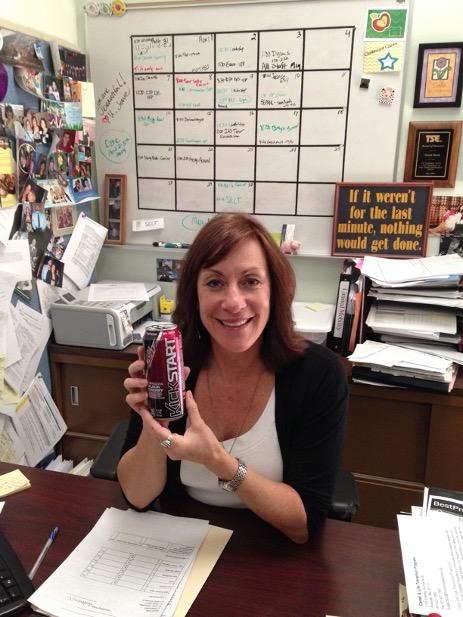
Photo: Susan in her teaching days, welcoming an energy drink |